Abstract
Combined femoral anteversion and tibial torsion deformity represents a complex rotational malalignment of the lower extremity and is a common cause of persistent intoeing gait in children. Although isolated femoral anteversion and internal tibial torsion frequently resolve spontaneously during growth, severe deformities may persist and result in gait abnormalities, functional limitations, cosmetic concerns, and psychosocial distress. Accurate clinical assessment of the rotational profile remains essential for diagnosis and treatment planning. Surgical intervention is reserved for symptomatic patients with significant rotational deformities that persist beyond the age of expected spontaneous correction. We report a case of a 9-year-old child with symptomatic combined femoral anteversion and bilateral internal tibial torsion who underwent bilateral distal tibial and fibular derotation osteotomy with approximately 40° correction. Postoperatively, the patient demonstrated marked improvement in gait pattern, functional mobility, and confidence during ambulation. This case highlights the effectiveness of distal tibial derotation osteotomy in appropriately selected patients.
Keywords: Femoral anteversion, tibial torsion, intoeing gait, rotational deformity, pediatric orthopaedics, derotation osteotomy.
Introduction
Rotational deformities of the lower extremity are among the most common reasons for referral to pediatric orthopaedic clinics. Intoeing gait may originate from abnormalities at the femoral, tibial, or foot level, with femoral anteversion and internal tibial torsion being the predominant causes in school-aged children.
Combined femoral anteversion and tibial torsion produce significant rotational imbalance of the lower extremity, leading to abnormal gait mechanics and functional impairment. While most cases improve spontaneously during skeletal growth, persistent severe deformities beyond the expected age of correction may require surgical management. Advances in clinical rotational profile assessment and derotation osteotomy techniques have improved outcomes and patient satisfaction.
Case Report
A 9-year-old child presented with inward turning of both lower limbs during walking. The parents reported progressive intoeing gait associated with difficulty in running and frequent stumbling.
Clinical examination revealed combined femoral anteversion and bilateral internal tibial torsion, resulting in a significant internal foot progression angle during ambulation. Rotational profile assessment confirmed the presence of clinically significant deformity affecting both lower extremities.
The diagnosis of combined femoral anteversion with bilateral internal tibial torsion deformity was established. Considering the patient’s age, persistent symptoms, functional limitations, and severity of deformity, surgical correction was planned.
The patient underwent bilateral distal tibial and fibular osteotomy with rotational correction of approximately 40° bilaterally. Tibial osteotomies were stabilized using plate-and-screw fixation, while fibular osteotomies were stabilized with K-wire fixation.
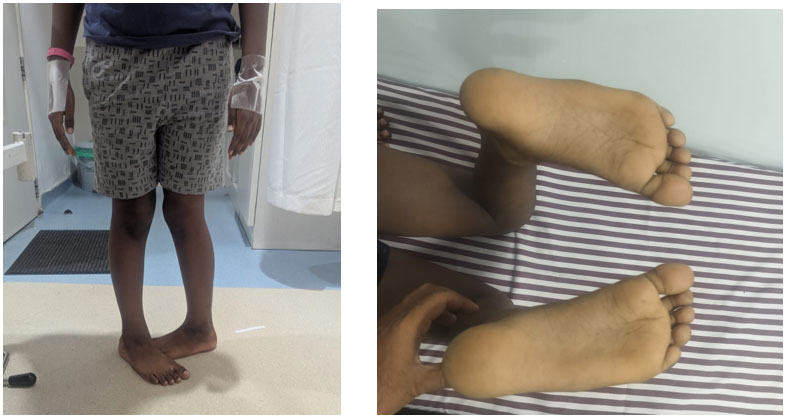
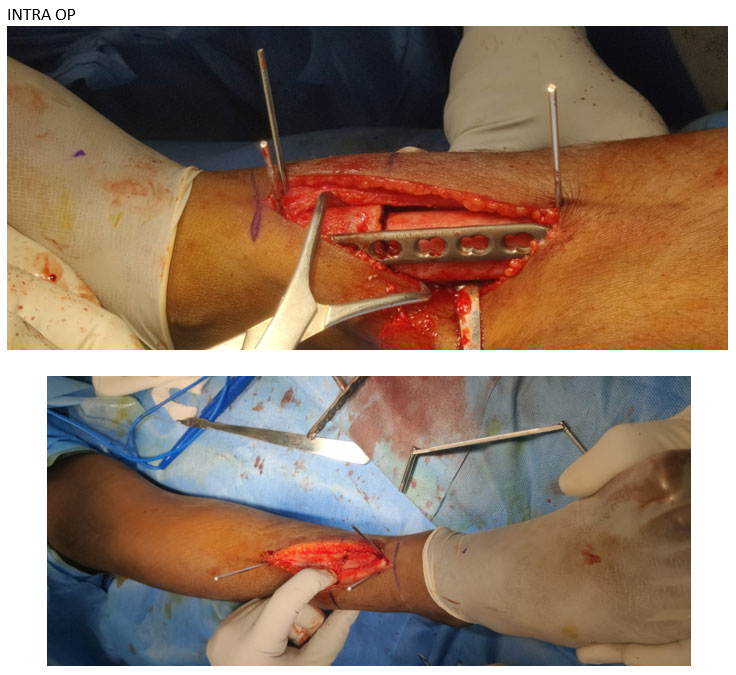
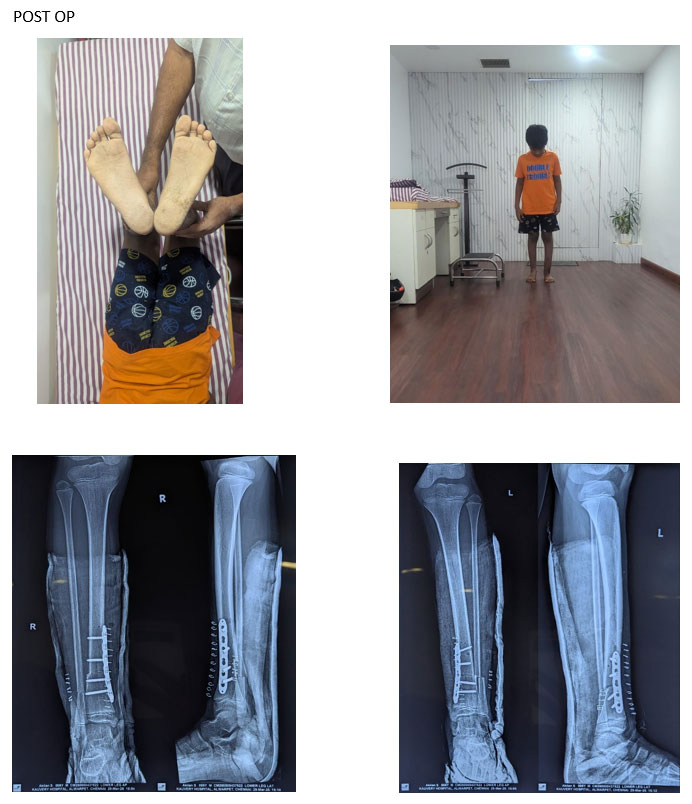
Postoperatively, the patient was managed with above-knee plaster slab immobilization for four weeks, followed by progressive mobilization and full weight-bearing ambulation after slab removal. Regular clinical and radiographic follow-up demonstrated satisfactory healing of the osteotomy sites.
At three months follow-up, there was marked improvement in foot progression angle and gait pattern. The patient was able to ambulate confidently without noticeable intoeing, and both functional and cosmetic outcomes were satisfactory.
Discussion
Combined femoral anteversion and tibial torsion deformity is a clinically important cause of persistent intoeing gait in children. Accurate diagnosis requires a systematic rotational profile examination, including assessment of foot progression angle, hip rotation, thigh-foot angle, and transmalleolar axis.
Most cases improve spontaneously with growth. Femoral anteversion generally remodels until 10–12 years of age, while internal tibial torsion often corrects by 6–8 years. Persistent severe deformities beyond these ages are unlikely to resolve and may lead to functional disability, recurrent tripping, cosmetic concerns, and psychosocial distress.
Surgical correction is typically considered in children older than eight years with significant symptomatic deformity. Derotation osteotomy remains the standard surgical treatment. Distal tibial derotation osteotomy offers several advantages, including reliable correction, technical simplicity, and lower neurovascular complication rates compared with proximal tibial osteotomy.
In the present case, bilateral distal tibial and fibular osteotomy with approximately 40° derotation successfully corrected the rotational deformity. Stable fixation enabled satisfactory healing and progressive rehabilitation. Significant improvement in gait mechanics and patient confidence was observed within three months of surgery.
Published studies have consistently demonstrated favorable long-term outcomes following appropriately timed derotation osteotomy, with high rates of patient and parent satisfaction.
Conclusion
Combined femoral anteversion and tibial torsion deformity is a significant cause of persistent intoeing gait in children. Clinical rotational profile assessment remains the cornerstone of diagnosis. Although most deformities improve spontaneously with growth, severe symptomatic cases persisting beyond the expected age of correction may require operative intervention.
Distal tibial derotation osteotomy provides predictable correction with excellent functional and cosmetic outcomes. The present case demonstrates successful restoration of gait mechanics and improved quality of life following bilateral distal tibial and fibular derotation osteotomy.
References
Tachdjian MO. Pediatric Orthopaedics. 6th Edition.
Lovell WW, Winter RB. Lovell and Winter’s Pediatric Orthopaedics. 8th Edition.
Canale ST, Beaty JH. Campbell’s Operative Orthopaedics. 14th Edition.
Staheli LT. Rotational problems in children. Journal of Bone and Joint Surgery.
Fabry G. Clinical practice: static, axial and rotational deformities of the lower extremities in children. European Journal of Pediatrics. 2010;169(5):529–534.
Lincoln TL, Suen PW. Common rotational variations in children. Journal of the American Academy of Orthopaedic Surgeons. 2003;11(5):312–320.
Stevens PM, Gililland JM. Rotational osteotomies of the lower extremity. Journal of Pediatric Orthopaedics.
Fuchs R, Staheli LT. Torsional problems in children. Orthopedic Clinics of North America.

Dr. Asim Chundeli
1st year DNB Resident, Orthopedics
Kauvery Hospital, Chennai.[1]

Dr. William Abraham,
Consultant Orthopedic Surgeon
Kauvery Hospital, Chennai.[1]