INTRODUCTION
Nutcracker syndrome is a rare vascular compression syndrome caused by obstruction of the left renal vein. In the common anterior form, the left renal vein passes between the abdominal aorta and the superior mesenteric artery and becomes compressed within the aortomesenteric angle. This produces increased left renal venous pressure and may result in haematuria, proteinuria, left flank pain and collateral venous drainage.
It is important to distinguish Nutcracker phenomenon from Nutcracker syndrome. Anatomical compression of the left renal vein may be present in asymptomatic individuals; the term syndrome is generally used when the compression is associated with clinically significant symptoms
The condition is particularly challenging in children. Many paediatric patients can improve spontaneously with growth, and conservative treatment is generally preferred when symptoms are mild. However, severe persistent haematuria, debilitating flank pain, significant venous hypertension or failure of conservative treatment may lead to consideration of surgical intervention.
HISTORY
A 9-year-old male child was diagnosed with symptomatic Nutcracker syndrome due to left renal vein compression and was admitted for surgical management.
Informant by Mother.
The child had a history of haematuria associated with strenuous physical activity from approximately 3 years of age. He also had recurrent episodes of epistaxis from approximately 4 years of age. There was a history of significant left flank pain requiring regular analgesic treatment. The haematuria had subsequently become more frequent.
No H/o Lower respiratory tract infection.
Milestones Attained upto the age.
No H/o congenital malformation.
Previous haematological evaluation reportedly did not demonstrate an intrinsic coagulation defect or factor IX deficiency. Renal biopsy was reported as normal.
Preoperative evaluation:
On examination, the child was:
Conscious and oriented
Afebrile
Pulse: 96/min
Blood pressure: 110/75 mmHg
SpO₂: 98% on room air
Weight ;28kg.
Cardiovascular examination: S1 and S2 present
Respiratory examination: bilateral air entry present
Abdomen: soft, bowel sounds present
CNS: no focal neurological deficit
Investigations ;Hb-12.6,PCV -40.1
Blood grouping -A positive
Normal renal function and coagulation profile.
CT evaluation showed:
Aortomesenteric angle: approximately 27°
Narrowing at the left renal vein/IVC region
Evidence of left renal vein compression
Doppler evaluation demonstrated increased peak systolic velocity at the site of compression.
Venography demonstrated narrowing at the IVC–left renal vein junction with a reported pressure difference between the LRV and IVC.
The final diagnosis was:
Nutcracker syndrome – left renal vein compression.
Airway Examination:
Modified mallampatti grading -2
Neck movement -full
Mouth opening -full
Normal Dentition
No tonsillar Enlargement.
Anaesthetic Management: Under General Anaesthesia with controlled ventilation
- Pre-op-2 units of PRBC reserved.
- After preoperative preparation of child in preop room, child was sedated with Inj. Fentanyl 20mcg +Inj midazolam 1mg, supplemented with 4litre of O2. Shifted to OT.
- Child was secured with 20G IV line on both hands, Given Inj cefuroxime 750mg Iv after test dose.
- Child was induced with Inj Glyco 0.1mg Iv followed by Inj fentanyl 40mcg , Inj Propofol 60mg, Inj Cisatracurium 2mg.
- Child was secured with ET tube 5.5 size, fixed at 18cm, 5 Point Auscultation done and confirmed with Etco2, connected to ventilator with setting in VCV mode (Tv-300ml, RR-20/min, Peep-05)
- Intraoperatively (Inj.Morphine 3mg iv, Inj. Paracetamol 500mg Iv, Inj Dexamethasone 4mg )
- Introperatively Inj. Heparin 3000U given -Urine clear throughout the procedure.
- Intraoperative event went uneventful.
- Blood loss around -50ml
- MAP maintained 65-70 throughout surgery.
Crystalloids Fluid given Around 1800ml.
- Urine Output maintained 30-35ml/hr, totally Urine output -255ml.
- After Successful surgery, patient reversed with Inj Glyco 0.2mg +Inj Neostigmine 2.0mg -Extubation done, Shifted to ICU for monitoring.
- Post Extubation -vitals stable. The child shifted to ICU for monitoring.
- Postoperatively Inj paracetamol 500mg 8th hourly, Diclofenac suppository 12.5mg stat given, Inj fentanyl 20mcg Iv bolus given for pain management.
Aim to maintain:
- Stable arterial pressure
- Adequate renal perfusion
- Adequate oxygenation
- Appropriate ventilation
- Avoidance of significant sympathetic stimulation.
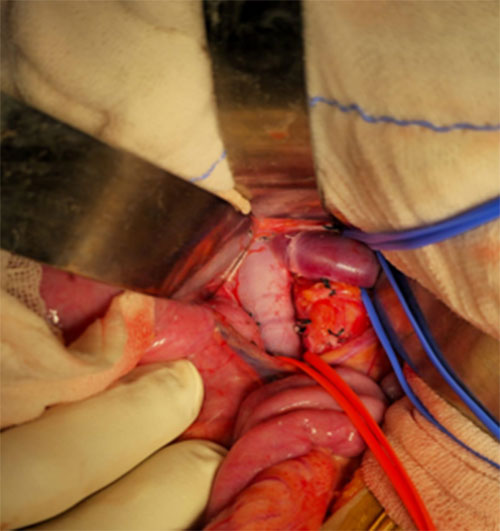
Condition on discharge:
Patient stable
Surgical site wound, thigh wound -Healthy.
Passed Urine-clear.
- Advised antiplatelet and anticoagulant.
- Discharged on day 5 of surgery and Advised review after 1week.
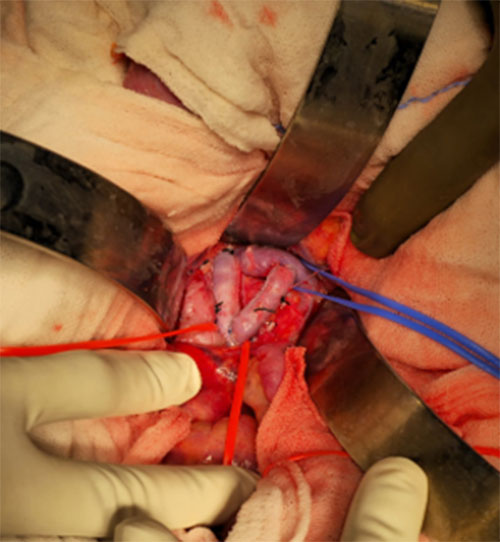
CONCLUSION:
- A 9-year-old male diagnosed with symptomatic Nutcracker syndrome with left renal vein compression. The child presented with recurrent haematuria and severe left flank pain, particularly following strenuous activity. Imaging demonstrated narrowing at the aortomesenteric region with evidence of left renal vein compression and a pressure gradient between the left renal vein and inferior vena cava. After multidisciplinary evaluation, the child underwent open left renal vein–inferior vena cava bypass using a panelled reversed great saphenous vein graft under general anaesthesia. The procedure involved midline laparotomy, extensive retroperitoneal dissection, mobilisation of the left renal vein and inferior vena cava, harvesting and preparation of the great saphenous vein, systemic heparinisation and vascular anastomosis.
- The anaesthetic priorities included adequate preoperative assessment of renal function and haemoglobin, haemodynamic monitoring appropriate to the extent of surgery, maintenance of adequate intravascular volume and renal perfusion, temperature management, acid-base and electrolyte monitoring, and coordinated management of anticoagulation during vascular clamping and graft anastomosis. Postoperatively, the patient was monitored in the intensive care unit and anticoagulation was continued according to the vascular surgical plan. The postoperative course was reported to be uneventful, and the child was discharged in a clinically stable condition.

Dr Rajesh K
DNB Resident (Anaesthesiology)
Kauvery Hospital, Chennai.[1]

Dr. Mahalakshmi
Senior Consultant
Kauvery Hospital, Chennai.[1]