Abstract
We describe the case of a 52-year-old woman with chronic arthritis and long-term analgesic exposure who presented with constitutional symptoms and rapidly progressive renal dysfunction. Renal biopsy revealed pauci-immune crescentic glomerulonephritis with necrotizing vasculitis, consistent with MPO-ANCA associated vasculitis. Early immunosuppression with pulse steroids and cyclophosphamide, combined with plasmapheresis, led to progressive improvement in renal function. By September 2026, after the third cyclophosphamide dose, serum creatinine normalized to 0.9 mg/dl and the patient was successfully weaned off haemodialysis. This case highlights the importance of clinicopathological correlation in distinguishing vasculitis from drug-induced nephropathy and demonstrates the potential for complete renal recovery with timely intervention.
Introduction
ANCA-associated vasculitis (AAV) is a group of small-vessel vasculitis characterized by necrotizing inflammation and pauci-immune glomerulonephritis [1]. MPO-ANCA vasculitis typically presents with renal-limited disease and constitutional features [2]. Differentiation from mimics such as analgesic nephropathy or autoimmune arthritis is critical, as early immunosuppression can alter prognosis [3]. We present a case of MPO-ANCA vasculitis complicated by chronic arthritis and NSAID exposure, with complete renal recovery following aggressive therapy.
Case Presentation
A 52-year-old woman with hypertension for one and a half years, chronic arthritis involving both small and large joints for seven years, and regular analgesic use presented with generalized weakness of one week’s duration, myalgia and anorexia for one month, exertional dyspnoea, and low-grade fever for one week. On examination she was pale and febrile, with musculoskeletal changes consistent with chronic arthritis, hypertension, anaemia, and pedal oedema.
Laboratory evaluation revealed progressive renal dysfunction, with serum creatinine rising to 5.7 mg/dl and blood urea nitrogen to 107.9 mg/dl, accompanied by anaemia (haemoglobin 7.6 g/dl), leucocytosis, hypoalbuminemia, and urinary abnormalities including proteinuria, haematuria, and granular casts. Serological testing demonstrated MPO-ANCA positivity, while PR3-ANCA, anti-GBM antibodies, and ANA/dsDNA were negative, and complement levels were within normal limits.
Renal biopsy showed crescentic glomerulonephritis with fibrinoid necrosis and necrotizing vasculitis, confirming ANCA-associated vasculitis [1].
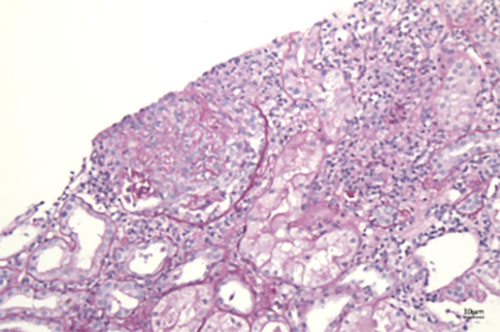
Image 1- H&E staining showing cellular crescents, diffuse moderate to focal dense mixed inflammation comprising of lymphocytes, plasma cells, histiocytes and many neutrophils and few eosinophils seen. Proximal convoluted tubules show intraluminal neutrophilic casts.
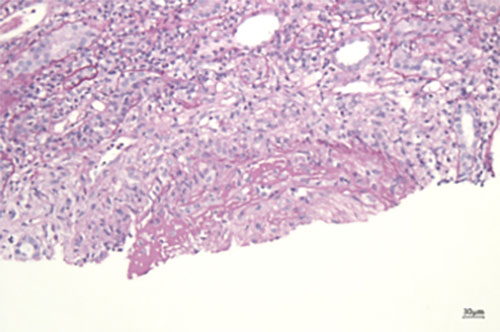
Image 2- H& E staining rupture of bowman’s capsule, eliciting dense lymphohistiocytic inflammation.
She was initiated on pulse steroids followed by cyclophosphamide, initially oral and subsequently intravenous, and underwent five sessions of plasmapheresis along with haemodialysis for uremic symptoms. Over the course of treatment, her renal function progressively improved, with creatinine decreasing to 2.86 mg/dl and dialysis frequency reduced from thrice to twice weekly. Following the second dose of cyclophosphamide on August 3, 2026, creatinine decreased to 2.09 mg/dl and she was weaned off haemodialysis. By September 5, 2026, her serum creatinine was 1.7 mg/dl, and after the third cyclophosphamide dose on September 2, 2026, creatinine normalized to 0.9 mg/dl with sustained dialysis independence.
Discussion
MPO-ANCA vasculitis results from neutrophil activation and endothelial injury, producing necrotizing vasculitis [1]. The case was confounded by chronic arthritis and analgesic use, initially suggesting drug-induced nephropathy. Renal biopsy confirmed pauci-immune crescentic GN. Early immunosuppression and plasmapheresis facilitated renal recovery, culminating in dialysis independence after the third cyclophosphamide dose.
This case underscores the importance of ANCA testing in unexplained renal failure [2] and highlights the role of biopsy in differentiating vasculitis from mimics such as NSAID nephropathy [3]. The patient’s complete renal recovery demonstrates that aggressive immunosuppression and adjunctive plasmapheresis can reverse severe renal dysfunction in MPO-ANCA vasculitis. Literature suggests that MPO-ANCA vasculitis, compared to PR3-ANCA, is more indolent but carries a higher risk of chronic renal involvement; however, our case demonstrates that timely therapy can achieve full recovery even in advanced disease [1,2].
Conclusion
MPO-ANCA vasculitis with renal involvement can present with diagnostic challenges when confounded by chronic arthritis and analgesic use. Clinicopathological correlation and timely therapy led to complete renal recovery and dialysis independence in this patient, emphasizing the importance of early recognition and aggressive management in ANCA-associated vasculitis.
References
- Jennette JC, Falk RJ, Bacon PA, et al. ANCA-associated vasculitis. N Engl J Med. 2013;369:1241–52.
- Jayne D. ANCA vasculitis: clinical features and management. Lancet. 2017;389:620–32.
- KDIGO Clinical Practice Guideline for Glomerular Diseases. 2021.

Dr C. Chaitra
Postgraduate in Nephrology
Kauvery Hospital, Chennai.[1]

Dr R. Balasubramaniam
Chief Nephrologist and Senior Consultant
Kauvery Hospital, Chennai.[1]

Dr Sangamitra Rajasekaran
Junior Consultant, Department of Pathology
Kauvery Hospital, Chennai.[1]