
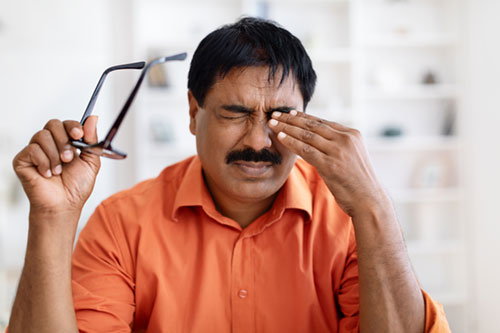
With aging, everybody notices changes in their eyes and vision. They often get worse over time if left untreated. Elderly eye care is of primary importance for a healthy, independent life during older age. Most of the elderly patients have co-morbid diseases that usually affect the eyes, depending on the duration and severity of the existing diseases. Therefore, the importance of elderly vision care can’t be stressed enough.
As a general rule, all elderly patients require periodic eye examination for early diagnosis and treatment. The common eye ailments of the elderly are:
- Presbyopia
- Floaters/Flashes
- Dry eyes
- Cataracts
- Diabetic retinopathy
- Hypertensive retinopathy
- Age-related macular degeneration
- Glaucoma
- Retinal degeneration/detachments
Treatment Modalities:
Presbyopia
Presbyopia is defective near vision with the advancement of age. All people crossing 40 years of age have difficulty reading fine print or doing fine work, which requires closer hand-eye coordination, which is due to weakening of zonules and loss of lens flexibility. This condition is corrected with hyperopic lenses. With each advancing year of age, the power of hyperopic lenses increases till 60 years. So, yearly refraction testing is advised.
Flashes/Floaters
Flashes or floaters in general, due to advancing age are relatively harmless. The gel inside the eye, called vitreous humour, which holds the eye in shape and protects the optic nerve from blunt forces, liquifies or collapses with the advancement of age, giving rise to floaters. They hardly affect vision and do not necessitate treatment. The flashes can be due to vitreous detachment from the retina and do not need treatment. However, persistent flashes need dilated retinal examination to rule out retinal traction and subsequent detachment.
Dry Eyes
With advancing age, the production of tears decreases, giving rise to dry eyes, which present with early morning redness, irritation and burning sensation in the eyes. Use of computer screens often increases the symptoms. This is usually treated with lubricant eye drops.
Cataracts
Even though cataracts can be found in all ages, they are primarily a disease of the elderly. The treatment for cataract usually depends on the degree of visual compromise. Immature cataracts do not damage vision and are usually treated with glasses. Mature cataracts and hypermature cataracts compromise clear vision and are usually treated by surgical expression of cataract and IOL implantation, after careful posterior segment evaluation.
Diabetic Retinopathy (DR) & Hypertensive Retinopathy (HR)
Diabetic retinopathy and hypertensive retinopathy are caused by diseases like diabetes and hypertension, affecting the retina. Depending on the duration of high sugar levels and BP levels, they both affect the retina in the long run. Persistent control of sugar and BP is the first line of treatment involved in diabetic and hypertensive retinopathies. Once the retina is affected, bleeding occurs inside the retina, swelling increases, the vision drops and the patient presents with blurred vision. Eye examination reveals swelling and bleeding spots. Scanning of the posterior segment is done with OCT/FFA and treatment is done accordingly with anti-inflammatory eye drops, laser photocoagulation or intraocular injections of anti-VEGF elements.
Age-Related Macular Degeneration (ARMD)
Age-related macular degeneration occurs in the prime visual area (macula) of the retina. As the name indicates, it is a neuronal degeneration that occurs due to aging and treatment involves neural supplements. Latest modalities like macular transposition surgeries are available, even though long-term results are unavailable.
Glaucoma
This condition has a genetic component and usually runs in families. Though raised eye pressure is a frequent accompaniment, rarely, the condition can rarely occur without raised eye pressure, called normal tension glaucoma. Various screening modalities are available to assess the degree of retinal and optic nerve compromise. Anti-glaucoma medications and surgeries are available to bring down the eye pressure, along with neurotrophic medications to take care of the optic nerve.
Retinal Detachments (RD)
Even though rare, retinal detachments cause considerable and permanent vision loss. Hence, periodic eye examination is advised. The treatment includes treating the underlying cause and re-attachment of the retina with regular retinal evaluations.

Dr. Sudha Bhuvaneshwari
Associate Consultant in Ophthalmology,
Kauvery Hospital, Chennai