

Communication is central to human life. From a child’s first word to an adult’s ability to express thoughts clearly, speech, language, and hearing shape how we connect with the world. Yet, problems in these areas are often overlooked or underestimated—leading to delayed diagnosis and avoidable complications.
May is observed as Speech, Language & Hearing Month, a reminder that awareness alone is not enough—we must focus on timely recognition and early intervention.
Understanding the Basics
Speech refers to the ability to produce sounds and words. Language is the ability to understand and use those words meaningfully. Hearing plays a crucial role in both—without proper hearing, speech and language development can be significantly affected.
A problem in any one of these areas can impact communication as a whole.
Speech Delay in Children: When Waiting Becomes Risky
One of the most common concerns parents face is delayed speech in children. While some children may develop slightly later than others, persistent delay should never be ignored.
A child should be evaluated if he/she does not:
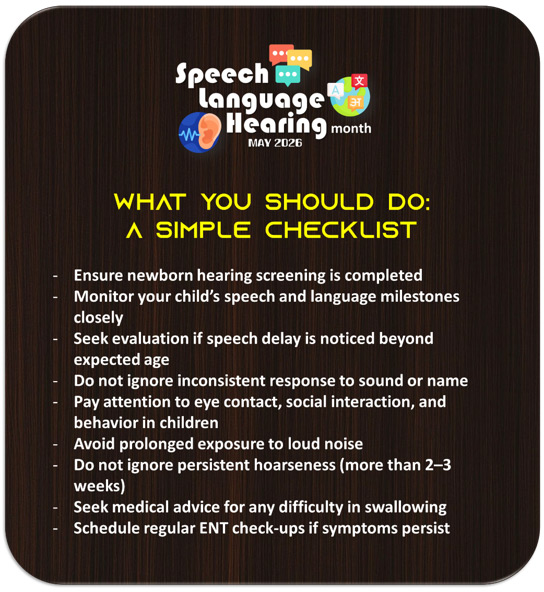
- Respond consistently to sounds
- Babble by 9 months
- Speak simple words by 1–1.5 years
Speech delay may be linked to hearing loss, developmental conditions, or environmental factors. Early identification allows for timely intervention, which can significantly improve outcomes. Waiting in the hope that the child will “catch up” often leads to lost time that cannot be regained.
A Real-World Example from Clinical Practice
A 3-year-old girl was brought to my clinic with the concern that she responded to her name only occasionally. The parents were worried about her hearing.
On evaluation, her hearing appeared normal. However, what stood out was something else—poor eye contact, minimal speech, and noticeable hyperactivity.
At this stage, the concern was no longer just about hearing. I explained to the parents that the delay in seeking medical attention had already cost valuable time. The child was referred to the Institute of Child Health and Hospital for Children for further evaluation, where she is now undergoing treatment for autism.
This case highlights an important point: assessing speech and hearing is not only about identifying deafness. It often helps uncover deeper developmental concerns that require early intervention.
Hearing Loss: A Hidden Problem
Hearing loss is often called a “silent disability” because it is not always obvious. In children, it may present as poor attention or delayed speech. In adults, it may be mistaken for distraction or lack of focus.
Common causes include:
- Ear infections
- Wax impaction
- Noise exposure
- Age-related changes
When left untreated, hearing loss can affect education, work performance, and social interaction. In older adults, it is also associated with social withdrawal and cognitive decline.
Routine hearing screening, especially in newborns and high-risk individuals, is essential.
Voice Changes: A Warning Sign Not to Ignore
A change in voice quality is often neglected, particularly among individuals who use their voice extensively—teachers, singers, and public speakers.
However, hoarseness lasting more than two to three weeks requires medical evaluation. Causes may range from simple vocal strain to more serious conditions such as vocal cord lesions or early cancers.
Early diagnosis not only improves treatment outcomes but may also help preserve voice quality.
Swallowing Difficulties: More Than a Minor Issue
Difficulty in swallowing is another symptom that is frequently ignored. Patients may experience coughing while eating, a sensation of food sticking in the throat, or discomfort during swallowing.
These symptoms can be due to infections, structural problems, or neurological disorders. In some cases, they may indicate serious underlying conditions, including head and neck cancers.
Prompt evaluation is crucial to identify the cause and initiate appropriate management.
Why Early Intervention Matters
Across all these conditions, one factor consistently determines outcome—timing.
Early detection allows:
- Better treatment results
- Reduced complications
- Improved quality of life
Delayed care, on the other hand, often leads to more complex treatment and limited recovery.
The Take-Home Message
Speech, language, and hearing are not separate functions—they are interconnected and essential for daily life. More importantly, they often serve as early indicators of broader health and developmental issues.
Ignoring early signs can lead to long-term consequences, while timely action can change the course of a patient’s life.
Awareness is important—but acting early is what truly makes the difference.

Dr Kingston S
Consultant ENT & Head-Neck Surgeon
Kauvery Hospital, Chennai