
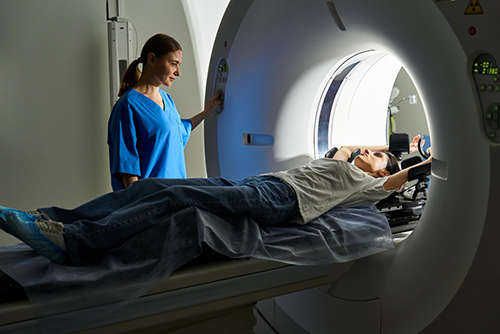
Earlier detection. Greater peace of mind. Many lung conditions, including early lung cancer, cause no symptoms until they are advanced. Finding a small nodule or infection early can change the outcome entirely. Radiation used to be the worry; modern scanners have changed that.
What Is an Ultra-Low-Dose Chest CT?
It is a chest CT set to use the least radiation needed for clear lung images: about 0.2 mSv, roughly 30 times less than a standard chest CT (5–7 mSv). Studies show that it still reliably picks up nodules, pneumonia, fluid and scarring, and finds far more than a plain chest X-ray.
How Little Radiation? The Flight Comparison
At cruising altitude, there is less atmosphere to shield us, so passengers absorb about 0.003–0.005 mSv of cosmic radiation every hour.
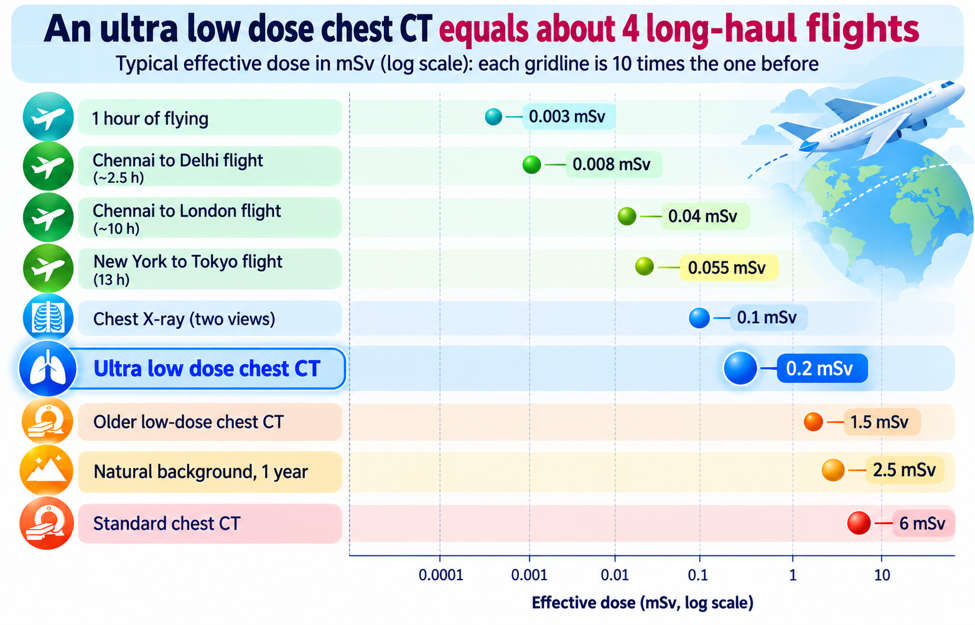
One scan is about:
- 65 hours of flying, or roughly four New York–Tokyo flights
- Five one-way Chennai–London trips
- One month of the natural radiation we all receive from the ground, air and sky
Why Choose Ultra-Low-Dose Chest CT?
- Safer: About 0.2 mSv, a small fraction of a standard CT.
- Accurate: Provides detailed cross-sectional images of the lungs, enabling detection and characterization of abnormalities that may not be visible on a chest X-ray. The appropriate imaging test depends on the clinical indication.
- Faster: The scan itself takes only seconds, a single breath-hold.
- Comfortable: Non-invasive, no needles, and no contrast injection.
Who Is It For?
Your doctor may recommend it for:
- Lung cancer screening in high-risk people, such as long-term smokers and former smokers.
- Following up lung nodules found on an earlier scan.
- Assessing lung infections such as pneumonia or COVID-19.
- Detecting interstitial lung disease and other chronic lung conditions.
- Post-treatment follow-up, for example after cancer therapy.
Because the dose is so low, it is well suited to people who need repeat scans over time.
Chennai’s Air and Your Lungs
Chennai’s air is not as bad as Delhi or Mumbai, but it is not safe. Last winter, harmful fine dust (PM2.5) averaged 44 µg/m³, up from 36 the year before. The WHO safe level is 5.
AQI (air quality index) is a daily score for how polluted the air is: 0–50 is good, and above 100 is unhealthy. Check it on the SAMEER or IQAir app.
- AQI 249 on Bhogi 2026, “very unhealthy”, with smog delaying flights.
- AQI above 100 on most days in January–February 2026.
- Velachery logged the highest daily PM2.5 peak at 193 µg/m³ (13 times the safe daily level), while Alandur and Manali topped the list of polluted zones with seasonal averages of 47 µg/m³ each in January 2025.
How Polluted Air Can Cause Lung Cancer
PM2.5 particles are about 30 times thinner than a human hair. They travel deep into the lungs, and over years they inflame and damage lung cells. The WHO’s cancer agency (IARC) classifies this particulate pollution as a Group 1 carcinogen, the same category as tobacco smoke.
A major 2025 study in The Lancet Respiratory Medicine found lung cancer is rising among people who have never smoked. Their most common type is adenocarcinoma, making up 53–70% of cases, and outdoor particle pollution was linked to about 195,000 such cases worldwide in 2022. Indian doctors report the same shift: more women, younger adults and non-smokers are being diagnosed.
Why Early Screening Matters
India recorded about 112,659 new lung cancer cases and 98,687 deaths in a year. Deaths are so close to cases because most lung cancers here are found late, often first mistaken for TB or a lingering cough.
An ultra-low-dose chest CT can spot a nodule just a few millimetres across, years before symptoms, when treatment works best.
Chest X-rays remain a valuable first-line investigation for many clinical conditions. However, for lung cancer screening in eligible individuals, ultra-low-dose chest CT offers greater sensitivity for detecting small pulmonary nodules. The goal is not to replace chest X-rays, but to select the right imaging modality for the right patient and clinical indication.
Proven here at Kauvery Hospital, Chennai: During the COVID-19 pandemic, our team successfully used low-dose chest CT to detect COVID pneumonia, giving patients a fast, reliable diagnosis with minimal radiation. That same experience now supports lung screening for our community.
Screening guidelines are still built mainly around smoking history, so if you are a non-smoker worried about pollution, family history or long exposure to traffic, smoke or industrial air, ask your doctor whether a scan makes sense for you.
What to Expect on the Day
- Wear comfortable clothes.
- You lie on your back on the scanner table, which slides through an open ring.
- The radiographer asks you to hold your breath for a few seconds while the scan runs.
- You can go home and resume normal activities straight away. A radiologist reviews the images and sends the report to your doctor.
Early Detection Can Save Lives
If you smoke or used to, have a family history of lung disease, or have a lingering cough or breathlessness, ask your doctor whether an ultra-low-dose chest CT is right for you. Screening is most useful when a doctor matches it to your personal risk.
Healthy lungs. Brighter tomorrows.
*Radiation figures are typical values and vary by scanner, body size and flight route.

Dr Asik Ali, MD
Consultant Radiologist
Cardiovascular & Pulmonary Imaging
Kauvery Hospital, Chennai

Dr Iyappan Ponnusamy, MD, FRCR
Chief Radiologist & Medical Director
Interventional Radiology
Kauvery Hospital, Chennai