
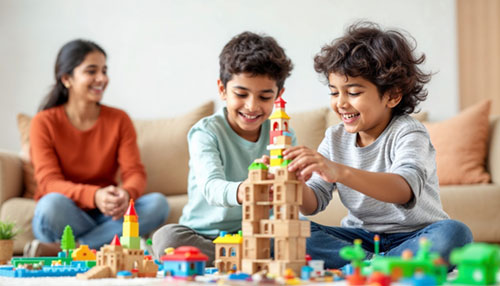
Every child is special. From the very beginning, children grow, learn, and experience the world in their own individual ways.
While it is natural for parents and caregivers to compare, it is important to remember that no two children develop alike.
Each child follows a personal path shaped by their abilities, environment, experiences, and temperament.
Children develop at their own pace
Developmental milestones such as walking, talking, and learning new skills do not happen at the same time for every child.
Some may walk earlier, while others take a little longer — and both can be perfectly normal.
Children thrive when they are given the time and space to develop comfortably and confidently.
Strengths and challenges can co-exist
Child development happens across different areas — speech and language, movement, thinking skills, social interaction, and emotional regulation. These areas are interconnected, but they do not always progress at the same pace.
A child may have delayed speech but strong understanding and problem-solving skills. Another child may struggle with coordination but be socially warm and engaging. Strengths and challenges can exist together.
If there is a delay in a particular area, it should be recognised clearly. A delay means support may be needed. It does not mean the child is weak in every area — but it does mean it should not be ignored.
Early detection allows us to understand a child’s developmental profile and begin timely support. Early intervention can strengthen skills, prevent gaps from widening, and help children build confidence as they grow.
Noticing early is not about labelling — it is about enabling children to reach their potential.
Differences are a natural part of childhood
Children vary in how they talk, move, behave, and express emotions.
These differences do not automatically signal a problem.
Every child — regardless of strengths, challenges, or developmental pace — needs active engagement and stimulation to support learning and connection.
Screen time should never replace conversation, shared activities, and real-world experiences that build communication, curiosity, and emotional bonding.
Developmental differences are not a reflection of parenting
Many parents quietly wonder if they have done something wrong when they notice differences in their child’s development.
Development is influenced by genetics, biology, and individual temperament.
What truly supports a child is consistent love, reassurance, encouragement, and a responsive environment.
On this Women’s Day, it is important to recognise that women — whether mothers, caregivers, or educators — often form the emotional foundation of a child’s world.
When women feel supported and valued, they are better able to nurture with confidence and patience. Empowering women strengthens families, and strong families provide the secure base children need to grow and flourish.
Focus on progress, not comparison
Instead of concentrating on exact ages or comparing children with peers, observe steady progress over time.
Small steps — learning a new word, improving coordination, showing curiosity, or engaging more socially — are meaningful signs of development.
Seek guidance when needed
Parents should consider seeking professional guidance if:
- A child loses skills they previously had (for example, stops speaking words they were using).
- There is very limited eye contact, response to name, or social interaction.
- Speech is significantly delayed compared to peers.
- The child does not attempt to communicate needs through words, gestures, or expressions.
- There are persistent concerns about behaviour, learning, or emotional regulation.
- Something consistently feels “not quite right” despite reassurance.
Trusting your instinct as a parent is important.
Being alert does not mean being anxious — it means being informed.
Early support makes a meaningful difference
When concerns are recognised early, timely guidance and intervention can positively influence a child’s developmental journey.
Reaching out for help is not a sign of failure — it reflects awareness, responsibility, and care.
Every child blossoms in their own time.
A child’s development is not a race, but a journey — notice early, nurture consistently, and support at the right time along the way.

Dr Naveena Karthik
Developmental Behavioural Paediatrician,
Kauvery Hospital, Chennai