

When most people hear the word “cancer”, they usually think of cancers such as oral cancer, throat cancer, breast cancer, or lung cancer. Medically, many of these belong to a group called carcinomas. But there exists another rare and very different category of cancer called sarcoma, one that many people have never heard about.
July is observed globally as Sarcoma and Bone Cancer Awareness Month, making it the perfect time to understand this uncommon but important disease.
Sarcoma vs. Carcinoma: What’s the Difference?
The human body is made up of different kinds of tissues.
- Carcinomas arise from the cells lining organs and body surfaces, such as the skin, mouth lining, throat, lungs, or breast. These are the cancers most commonly seen in the public.
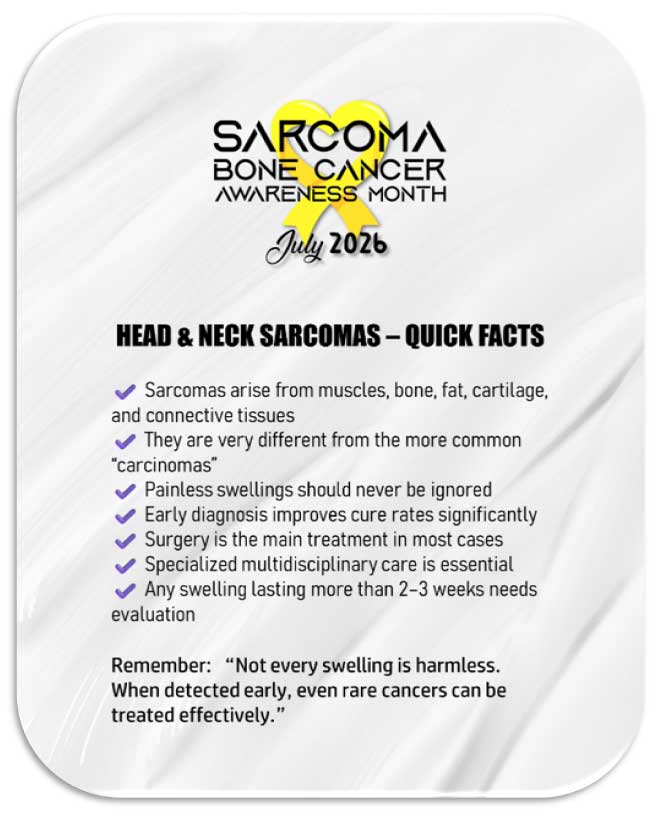
- Sarcomas, on the other hand, arise from the body’s supporting tissues, including muscle, fat, bone, cartilage, blood vessels, fibrous tissue, and connective tissue.
In simple terms, carcinomas come from the “covering” tissues, while sarcomas arise from the “framework” tissues of the body.
Sarcomas are rare, accounting for less than 1% of all adult cancers. Yet, despite their rarity, they can occur almost anywhere in the body, including the head and neck region.
What Are Head and Neck Sarcomas?
Head and neck sarcomas are cancers arising from soft tissues or bones in areas such as:
- Face
- Jaw bones
- Neck muscles
- Salivary glands
- Nose and sinus area
- Skull base
- Throat and voice box region
Unlike common oral cancers that are strongly linked to tobacco and alcohol, sarcomas often occur without obvious lifestyle-related causes.
Some commonly encountered head and neck sarcomas include:
- Osteosarcoma
- Chondrosarcoma
- Rhabdomyosarcoma
- Fibrosarcoma
- Liposarcoma
- Angiosarcoma
Certain sarcomas are more commonly seen in children and young adults, while others occur later in life.
Why Are Sarcomas Challenging?
Sarcomas are often called the “silent tumours” because they may grow quietly without causing symptoms initially. Many patients mistake them for harmless swellings or ignore them because they are painless.
A small swelling in the neck, face, jaw, or nasal region that gradually enlarges over weeks or months should never be ignored.
Symptoms may include:
- Persistent swelling in the face or neck
- Nasal blockage or bleeding
- Jaw swelling or loosening of teeth
- Difficulty swallowing
- Voice change
- Facial pain or numbness
- Non-healing lump inside the mouth
Because these symptoms can mimic infections or benign conditions, diagnosis is sometimes delayed.
Diagnosis: Why Expertise Matters
Diagnosing sarcomas is not straightforward. Unlike common cancers, sarcomas require careful coordination between:
- ENT & head-neck surgeons
- Radiologists
- Pathologists
- Medical oncologists
- Radiation oncologists
Advanced imaging, such as a CT scan or MRI, is usually needed to understand the extent of the disease. A biopsy confirms the diagnosis.
One major challenge is that sarcomas are not a “single disease”. There are more than 50 subtypes, each behaving differently and requiring individualized treatment planning.
Treatment: Surgery Remains the Cornerstone
For most head and neck sarcomas, complete surgical removal offers the best chance of cure.
This is often technically demanding because the head and neck region contains critical structures responsible for speech, swallowing, breathing, hearing, and facial appearance. Preserving function while ensuring complete cancer clearance is a delicate balance.
Depending on the type and stage of sarcoma, treatment may also involve:
- Radiation therapy
- Chemotherapy
- Targeted therapy in selected cases
Can Sarcomas Be Prevented?
Unfortunately, many sarcomas do not have clearly identifiable preventable causes. However:
- Early diagnosis greatly improves outcomes
- Persistent swellings should not be ignored
- Any unusual lump lasting more than 2–3 weeks deserves medical evaluation
Awareness is the first step toward timely treatment.
Final Message
Sarcomas may be rare, but rarity should never lead to neglect. Awareness among the public can help identify warning signs earlier and improve survival outcomes.
In cancer care, early attention saves lives, and sometimes, even a seemingly harmless swelling may tell an important story.

Dr. Kingston S.
ENT & Head-Neck Surgeon
Kauvery Hospital, Chennai