
Kauvery Hospital Alwarpet Successfully Treats Brain Bleed in 65-Year-Old Using Advanced, Non-Surgical Procedure
Chennai, 1st August 2025: A 65-year-old individual who arrived at Kauvery Hospital Alwarpet with symptoms suggestive of a stroke was found to have bilateral subdural hemorrhage — bleeding on both sides of the brain. While an emergency brain surgery helped relieve initial pressure, follow-up imaging showed that bleeding had started reaccumulating. To avoid a second surgery, doctors turned to an advanced, minimally invasive approach: Middle Meningeal Artery Embolization.
The individual initially presented with a severe headache and weakness on one side. A CT scan and MRI revealed blood collection on both sides of the brain, with significant pressure on the right side, shifting brain structures — a critical condition requiring urgent surgical intervention. After the procedure, recovery was smooth, and discharge followed soon after.
However, during a follow-up, imaging showed that bleeding was beginning to build up again on both sides. Given the person’s age and recent surgical history, the medical team sought a safer, less invasive solution. “We chose Middle Meningeal Artery Embolization — a cutting-edge technique increasingly used around the world for managing chronic or recurring subdural hemorrhages,” Dr. Sathya Narayanan R, Senior consultant, Vascular Intervention Radiology, Kauvery Hospital, Alwarpet.
“This approach involves blocking small arterial branches that may be contributing to rebleeding, offering a preventive solution without open surgery. Earlier, it was believed that these bleeds were purely venous and that embolization wouldn’t help. But recent evidence suggests that tiny arteries, especially branches of the middle meningeal artery, play a key role in rebleeding. Blocking them can help stop further accumulation,” he added.
The procedure was performed under local anesthesia in the hospital’s advanced Cath Lab and took approximately 30 minutes. Both sides were treated in a single session. Post-procedure recovery was uneventful, and the individual was discharged the very next day with no neurological deficits. Subsequent follow up scans show decrease in size of the accumulated blood.
“This case is a strong example of how innovation in interventional radiology can change the way we treat brain conditions,” said Dr. Aravindan Selvaraj, Co-Founder & Executive Director, Kauvery Group of Hospitals. “Especially in older adults, avoiding repeat surgeries significantly lowers risk and improves overall recovery. Our commitment is to combine global expertise with personalized, safer care.”
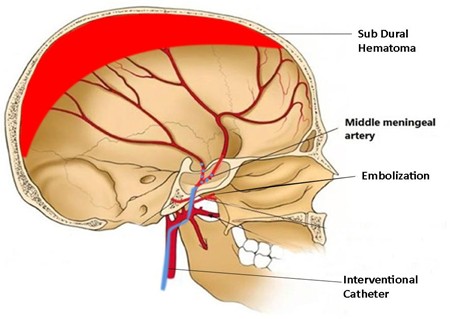
Illustration of the Subdural Hematoma and the Embolization Procedure
Middle Meningeal Artery Embolization is emerging as a powerful tool in stroke and neuro care — enabling quicker recovery, fewer complications, and enhanced quality of life, particularly for those where surgery might not be ideal.