
Orientia tsutsugamushi
- Orientia tsutsugamushiis a gram-negative organism belonging to the Rickettsiaceae family. Owing to its intracellular nature, scrub typhus can only be treated by antibiotics that accumulate in large quantities within the target cells.
- tsutsugamushiis an intracellular organism that proliferates and survives in endothelial cells and macrophages, adequate intracellular antibiotic concentrations are essential.
Clinical Trial findings:
Discussion
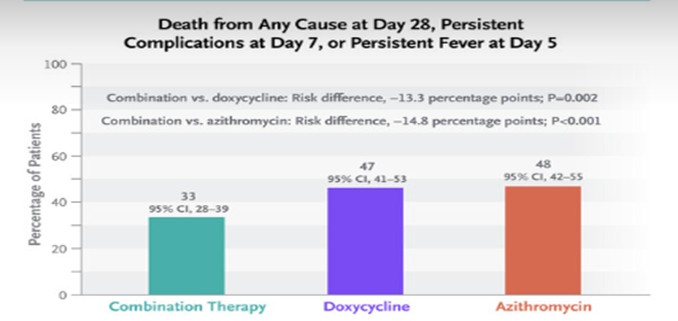
- “Combination therapy” with intravenous doxycycline and azithromycin is a better, more effective way to treat severe scrub typhus than monotherapies of either drug by itself.
- Azithromycin binds the 23SrRNA of the 50S ribosomal subunit at the polypeptide exit tunnel, and doxycycline prevents aminoacyl-tRNA binding to the 30S ribosomal subunit.
- Both antibiotics have excellent tissue penetration, and azithromycin accumulates intracellularly to concentrations that are 100 times as high as those in plasma. This penetration of azithromycin into eukaryotic and prokaryotic cells explains its broad spectrum of activity, specifically against intracellular pathogens.
- The more rapid clearance of O. tsutsugamushi DNA from the buffy coat in both of the azithromycin-containing regimens may reflect this factor and explain why adding azithromycin to doxycycline leads to improved clinical outcomes in severe disease.
- Many clinical trial study have found that when both azithromycin and doxycycline were administered together to patients with severe scrub typhus, the bacteria were cleared away quicker and patients improved faster with less complication and mortality.
Reference: Intravenous Doxycycline, Azithromycin, or Both for Severe Scrub Typhus, N Engl J Med 2023;388:792-803